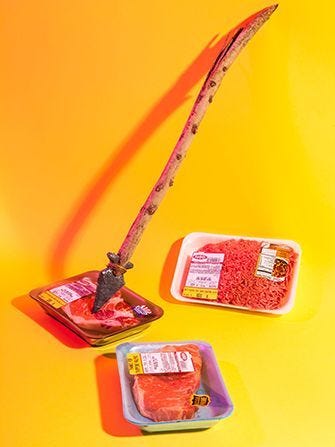
Grass Is Good
No, I’m not referring to recent legalized medical marijuana, but I do hear there are some great benefits to using it 😉 I am talking about grass fed animals vs. grain fed. With all of the new labeling in the market: GMO, “responsible sourced”, antibiotic free, wild vs. farm caught, there seems to be a lot of confusion about what is safe to eat and what foods are ok to ingest.
Let’s try to clear up some of the confusion:
GMO
We’ve covered this once before in a blog entry titled “What’s In A Label”.
GMO stands for Genetically Modified Organisms. The genetic material of food organisms have been altered using genetic engineering techniques, creating unstable genes that do not naturally occur. In the U.S., GMOs are in as much as 80% of conventional processed food. Most of which, are unlabeled in America.
GMOs are deemed bad for your body & environment as the health consequences of ingesting them are unknown and potentially dangerous. Controversy stems over whether or not GMOs are  rendered toxic when ingested as they require massive amounts of pesticides.
The best way to avoid GMOs is to buy organic.
Organic
A food labeled “organic” has specific guidelines defined by the United States Department of Agriculture (USDA) National Organic Program.
The guidelines state:
- Organic meat, poultry, eggs and dairy products come from animals that are not given antibiotics or growth hormones.
- Organic plant foods are produced without using most conventional pesticides, fertilizers made with synthetic ingredients or sewage sludge, bioengineering or ionizing radiation.
- A government-approved certifier must inspect the farm to ensure these standards are met. In addition to organic farming, there are USDA standards for organic handling and processing. There are three levels of organic claims on food labels:
o “100% Organic”: these products are completely organic or made of only organic ingredients and qualify for a USDA Organic seal.
o “Organic”: products in which at least 95% of its ingredients are organic and qualify for a USDA Organic seal.
o “Made with organic ingredients”: Products in which at least 70% of the ingredients are certified organic. The USDA organic seal cannot be used but “made with organic ingredients” may appear on its packaging.
FYI – did you know the little stickers on produce either come with 4 or 5 digits? Only produce with 5 digits and the number “9” in front of it are organic. Check out the labels on fruit next time you shop.
Natural
Take a walk down a supermarket aisle and you will see a flood of products labeled “natural”. This is basically marketing fluff.
The U.S. Food and Drug Administration nor the U.S. Department of Agriculture has issued a formal definition for the use of “natural” on food labels. The FDA follows policy from as far back as 1993. The USDA allows the use of the term “natural” to be used in meat and poultry labeling on products that contain no artificial ingredients or added color and is only minimally processed. The label must explain the use of the term natural. For example: “no added coloring” or “minimally processed”.
As good as the word “natural” sounds…it really doesn’t mean much.
Grass Fed vs. Grain Fed
This mostly pertains to the beef that we eat. There is a pretty significant difference in meat quality, based on the diet of the cows. Most cows do graze on a grass pasture; however, some cows are transitioned to a concentrated feed mix of corn, soy, grains, supplements, hormones and antibiotics to facilitate an advanced, unnatural growth spurt in the cows for the US beef industry to sell larger volumes, quicker. Basically, conventional factory meat is cheaper since they have sped up the growth while lowering the cost of the feed.
Bottom line – solely grass fed beef is said to be lower in calories, contains more healthy omega-3 fats, more vitamins, higher levels of antioxidants and 7x’s the amount of beta-carotene. Grass-fed beef is believed to have less health concerns than cows raised by unnatural means with added hormones and antibiotics.
Free-Range
Free-range refers to food (ie. meat or eggs) that are produced from animals that have access to outdoor spaces or are free to graze or forage for food. It does not mean organic.
Free-range, unlike organic, is not a certification. Organically raised food is free-range, meaning animals must have access to pasture, but to be certified organic, food must meet very strict criteria.
Free range food doesn’t have to meet any particularly stringent or even legal requirements. Access to outdoor spaces can mean as little as 15 minutes a day, which is why “organic” means so much more than free-range.
Wild vs. Farm Caught
Wild caught fish eat food from their natural environment including kelp, algae, seaweed and other fish, which gives them higher levels of vitamins and minerals.
Diets of farm raised fish often include genetically modified crops that are unnatural and nutrient-poor. Farm raised fish with industrial farming methods often include antibiotics, hormones, PCBs (potentially carcinogenic chemical), pesticides and toxins – causing fish to index high in mercury and other industrial toxins. Some farms (as in a video I recently watched) feed fish the feces of other animals and inject them with antibiotics to keep them alive. Just sayin’.
Gluten Free
The recent flood of “gluten free” products on the market has led to the belief that these products are healthier choices. This is not necessarily true. Gluten-free substitutes are often made with ingredients such as white rice flour, milled corn flour, even potato or corn starch – carbs with less fiber and higher glycemic indices than the original foods people are trying to avoid.
For some, gluten-free is a medical necessity including the 1% of the population who has celiac disease, an autoimmune disorder that damages the small intestine. Or, like millions of others, they may have a diagnosed gluten sensitivity that causes inflammation throughout the body. Research suggests the epidemic of sensitivities is a result of the refined, GMO processed foods that our bodies are unable to digest.
Unless it’s a necessity, gluten-free foods are not a solution to a healthier diet or weight loss. It’s important to read the labels to see what is substituted for gluten.
Made With Whole Grains
The “whole grain” stamp which appears on some food labels is misleading. Companies pay fees to belong to the Whole Grains Council, which administers the program. Qualifying products need only have eight grams of whole grains to bear this stamp on labels. So, a 2-ounce serving of pasta (56 grams) with 8 grams of whole wheat could actually come with 48 grams of white refined flour.
You will find the whole grain stamp on sugary cereals like Lucky Charms – giving a false sense of what is “healthy”. Food manufacturers making whole grain claims or using words like “multigrain” on labels are just hiding the fact these products are mostly made with highly refined white flour.
Don’t believe the hype.
“FED UP”, a recent movie release discussing the food industry and what it doesn’t want you to know, is playing at MONDO in Summit on October 17th. Click here for details. I’ll be there. Join me.
To leave a comment on this article or any other blog entry, please fill in the “Leave a Comment” box under each blog entry on our site: Heels to Laces